SpringBoot集成Knife4j接口文档
界面展示
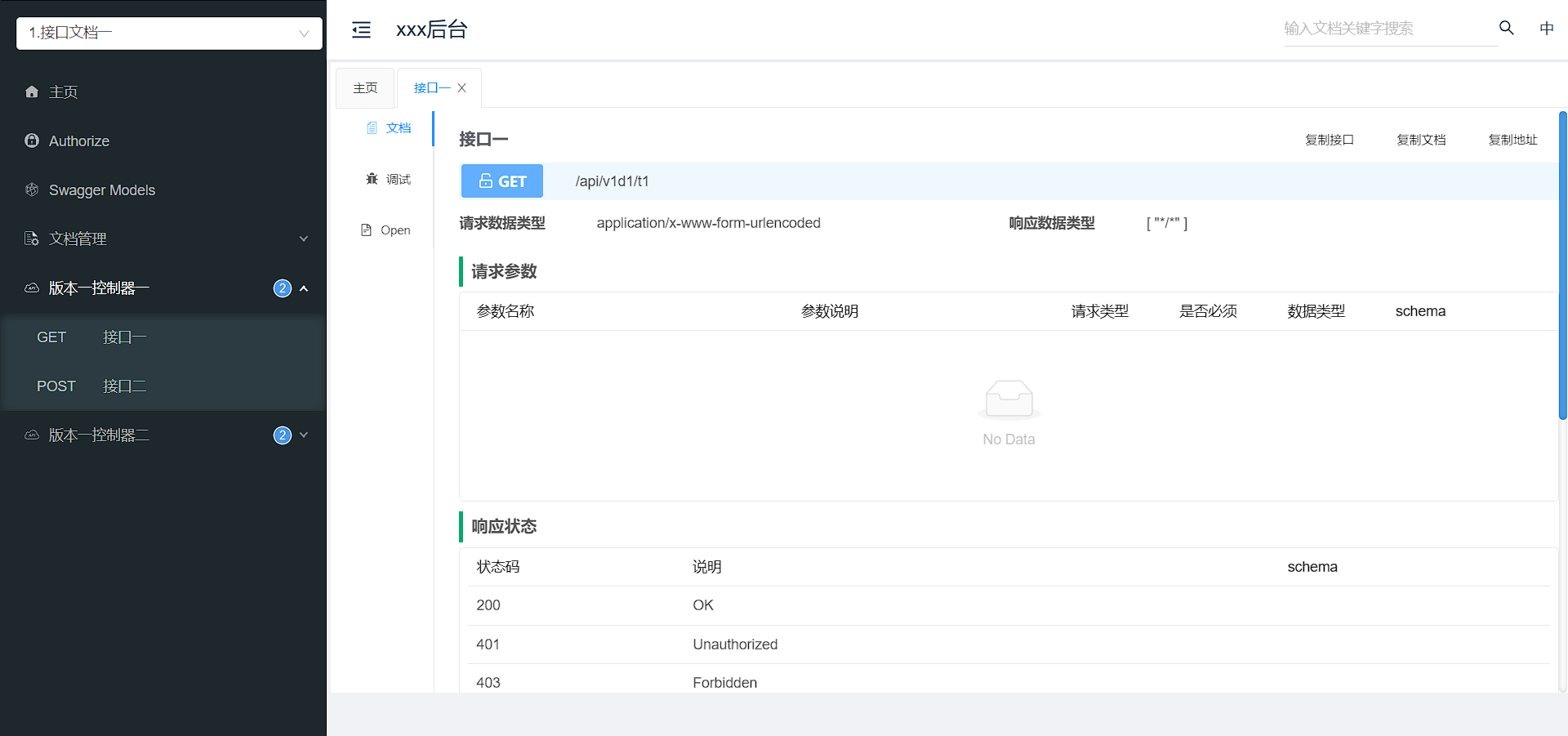
引入坐标文件
SpringBoot版本
<parent>
    <artifactId>spring-boot-starter-parent</artifactId>
    <groupId>org.springframework.boot</groupId>
    <version>2.6.9</version>
    <relativePath/>
</parent>
|
knife4j版本
<dependency>
<groupId>org.springframework.boot</groupId>
<artifactId>spring-boot-starter-web</artifactId>
</dependency>
<dependency>
<groupId>org.projectlombok</groupId>
<artifactId>lombok</artifactId>
</dependency>
<dependency>
<groupId>com.github.xiaoymin</groupId>
<artifactId>knife4j-spring-boot-starter</artifactId>
<version>3.0.3</version>
</dependency>
|
具体代码
注意:
如果引入的SpringBoot版本大于等于2.6,需要以下操作
在application.yml中加上以下配置
spring:
mvc:
pathmatch:
matching-strategy: ANT_PATH_MATCHER
|
application.yml中配置文件部分
swagger:
enable: true
title: "xxx后台"
description: "xxx后台描述"
version: "1.0.0"
pathMapping: /api
contact:
name: "xxx"
email: "xxxx@qq.com"
url: "https://xxxx.com"
groups:
- name: 1.接口文档一
basePackage: com.xxxx.controller.apiA
- name: 2.接口文档二
basePackage: com.xxxx.controller.apiB
knife4j:
enable: true
production: false
basic:
enable: false
username: username
password: password
setting:
language: zh-CN
enableFooter: false
enableDynamicParameter: true
enableReloadCacheParameter: true
|
SwaggerPropertise.java 用于获取application.yml中swagger一栏配置文件
@Data
@Component
@ConfigurationProperties(prefix = "swagger")
public class SwaggerProperties {

    private Boolean enable;
    private String title;
    private String description;
    private String pathMapping;
    private String version;
    private Contact contact;
    private List<Groups> groups;

    @Data
    @NoArgsConstructor
    public static class Contact {
        private String contact;
        private String name;
        private String email;
        private String url;
        private String groups;
    }

    @Data
    @NoArgsConstructor
    public static class Groups {
        private String name;
        private String basePackage;

    }
}
|
SwaggerConfig.java (Knife4j是实现,Swagger是规范)
@Configuration
@EnableKnife4j
public class SwaggerConfig {
@Resource
private SwaggerProperties properties;
@Resource
private OpenApiExtensionResolver openApiExtensionResolver;
@Bean
public BeanPostProcessor springfoxHandlerProviderBeanPostProcessor() {
return new BeanPostProcessor() {
@Override
public Object postProcessAfterInitialization(Object bean, String beanName) throws BeansException {
if (bean instanceof WebMvcRequestHandlerProvider || bean instanceof WebFluxRequestHandlerProvider) {
customizeSpringfoxHandlerMappings(getHandlerMappings(bean));
}
return bean;
}
private <T extends RequestMappingInfoHandlerMapping> void customizeSpringfoxHandlerMappings(List<T> mappings) {
mappings.removeIf(mapping -> mapping.getPatternParser() != null);
}
private List<RequestMappingInfoHandlerMapping> getHandlerMappings(Object bean) {
try {
Field field = ReflectionUtils.findField(bean.getClass(), "handlerMappings");
field.setAccessible(true);
return (List<RequestMappingInfoHandlerMapping>) field.get(bean);
} catch (IllegalArgumentException | IllegalAccessException e) {
throw new IllegalStateException(e);
}
}
};
}
@PostConstruct
public void createRestApi() {
for (SwaggerProperties.Groups group : properties.getGroups()) {
String basePackage = group.getBasePackage();
Docket docket = new Docket(DocumentationType.OAS_30)
.enable(properties.getEnable())
.apiInfo(getApiInfo())
.select()
.apis(RequestHandlerSelectors.basePackage(basePackage))
.paths(PathSelectors.any())
.build()
.groupName(group.getName())
.extensions(openApiExtensionResolver.buildExtensions(group.getName()))
.pathMapping(properties.getPathMapping())
.securitySchemes(securitySchemes())
.securityContexts(securityContexts());
String beanName = StringUtils.substringAfterLast(basePackage, ".") + "Docket";
SpringUtil.setBean(beanName, docket);
}
}
private List<SecurityScheme> securitySchemes() {
List<SecurityScheme> apiKeyList = new ArrayList<>();
apiKeyList.add(new ApiKey("Authorization", "Authorization", In.HEADER.toValue()));
return apiKeyList;
}
private List<SecurityContext> securityContexts() {
List<SecurityContext> securityContexts = new ArrayList<>();
securityContexts.add(
SecurityContext.builder()
.securityReferences(defaultAuth())
.operationSelector(o -> o.requestMappingPattern().matches("/.*"))
.build());
return securityContexts;
}
private List<SecurityReference> defaultAuth() {
AuthorizationScope authorizationScope = new AuthorizationScope("global", "accessEverything");
AuthorizationScope[] authorizationScopes = new AuthorizationScope[1];
authorizationScopes[0] = authorizationScope;
List<SecurityReference> securityReferences = new ArrayList<>();
securityReferences.add(new SecurityReference("Authorization", authorizationScopes));
return securityReferences;
}
private ApiInfo getApiInfo() {
SwaggerProperties.Contact contact = properties.getContact();
return new ApiInfoBuilder()
.contact(new Contact(contact.getName(), contact.getUrl(), contact.getEmail()))
.description(properties.getDescription())
.title(properties.getTitle())
.version(properties.getVersion())
.build();
}
}
|
SpringUtil工具类的实现
@Component
public class SpringUtil implements BeanFactoryPostProcessor {

    private static ConfigurableListableBeanFactory beanFactory;

    @Override
    public void postProcessBeanFactory(ConfigurableListableBeanFactory beanFactory) throws BeansException {
        SpringUtil.beanFactory = beanFactory;
    }

    public static ConfigurableListableBeanFactory getBeanFactory() {
        return beanFactory;
    }

    public static <T> void setBean(String name, T t) {
        beanFactory.autowireBean(t);
        beanFactory.registerSingleton(name, t);
    }

    public static <T> T getBean(String name) {
        return (T) beanFactory.getBean(name);
    }

    public static <T> T getBean(Class<T> clazz) {
        return beanFactory.getBean(clazz);
    }
}
|
基本注解
@Api()
用于在Controller类上描述,描述当前类的作用
tags:说明该类的作用,参数是个数组,可以填多个。
value="该参数没什么意义,在UI界面上不显示,所以不用配置"
description = "用户基本信息操作"
|
@ApiOperation()
用于在Controller类下方法上,描述当前方法的作用
value="方法的用途和作用"
notes="方法的注意事项和备注"
|
@ApiParam()
用在方法入参上,用于描述入参的类型,是否必填等信息
name="参数名称"
value="参数的简要说明"
defaultValue="参数默认值"
required="true" 表示属性是否必填,默认为false
|
@ApiModel()
用在实体类上,用于描述实体类信息
@ApiModelProperty()
用在实体类属性上,描述每个属性的作用,是否必须
value="姓名"  描述参数的意义
name="name"    参数的变量名
required=true     参数是否必选
|

 微信
微信 支付宝
支付宝